

What is an LED wall in plain terms?
The screen at home is one piece of fixed size. An event screen is different: it is small panels fitted side by side like tiles, so the technical team can build a wide backdrop behind the stage, two side screens, or a glowing strip around the platform. Because it emits its own light, it stays clear even under strong stage lighting, unlike a projected image that washes out in light.
What does pixel pitch mean and how do you choose it?
Pixel pitch is the distance between the centres of two neighbouring diodes, written in millimetres. A smaller number means more pixels in the same area and a smoother image up close. The common working rule is that the minimum viewing distance in metres is roughly the pitch in millimetres, and the comfortable distance is about three times that.
- Rooms with the audience close and panel stages: a fine pitch, because the front row is near.
- Grand halls and deep auditoriums: a coarser pitch is acceptable since most of the audience is far.
- Outdoor sites: higher brightness to cope with daylight.
Run your own numbers in the screen size and viewing distance calculator.
How are LED walls used at conferences and forums?
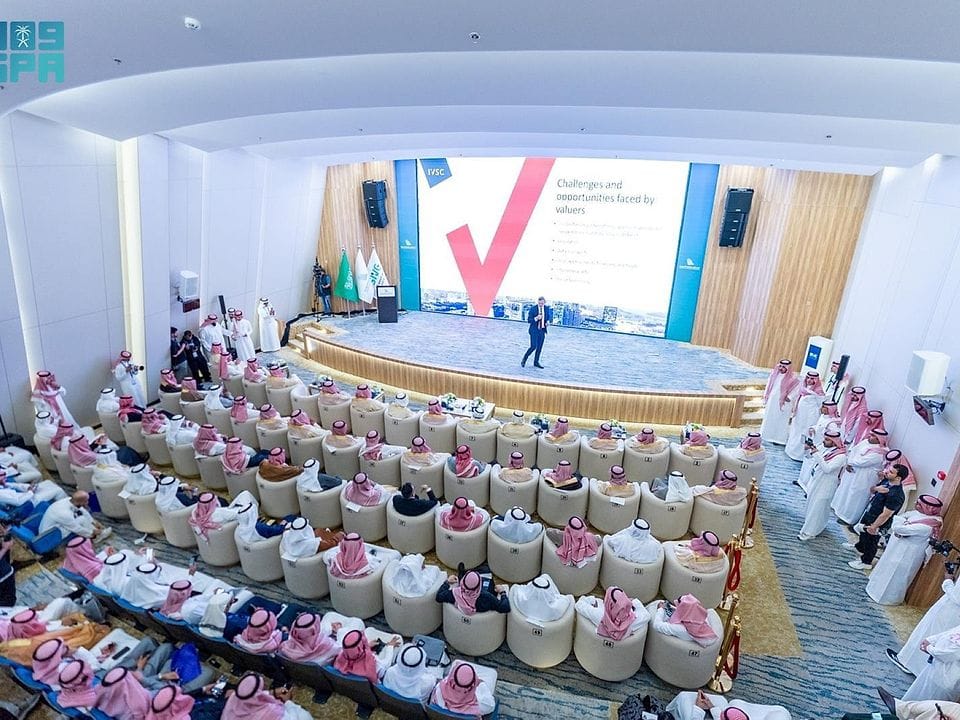
At the Najran Investment Forum 2025 the wide screens were part of the main stage design together with a full lighting ceiling, and at the Hafar Al-Batin Investment Forum 2025 LED screens were part of the main stage. Wide rooms such as the hotel ballrooms in Khobar suit extended walls across the stage. Heritage sites such as AlUla, on the other hand, suit subtle architectural lighting better than large screens.
Content is part of the screen itself: logos, speaker names, the opening film and motion graphics in the event identity, designed for the real proportions of the wall as built, which are not always 16:9.
What are the common mistakes with LED walls?
- Designing content in a different aspect ratio from the wall as built, leaving black edges or cropping the image.
- Choosing a coarse pitch for a room whose front row sits close to the stage.
- Ignoring ceiling height and rigging when setting the height of the wall.
- Excessive brightness in a dark room, which tires the eyes and spoils the photography.
For the full comparison with projection see the LED wall versus projector comparison.
How is an LED wall installed in a hall?
The wall starts on the plan: the technical team sets its size in modules, its position relative to the stage and how it is supported, either on a ground-stacked frame behind the stage or flown from the ceiling where the venue allows. The modules then arrive in cases, are assembled row by row, and are connected to the video processor that spreads the content across the modules as if they were one screen.
After assembly comes calibration: colour and brightness are balanced so the modules look uniform, then every piece of event content is tested on the real wall from different seats, including the back row. The control room stays connected throughout the event, with a backup playback machine holding the same content. That is why we ask for enough set-up time in the venue before the day; a large wall is not built and tested in an hour.

 Scan to chat on WhatsApp